


Food-Grade Ziplock Bags: FDA & EU Compliance Guide 2026
Back to previous pageWalk into any supermarket and you will see them: resealable bags protecting everything from fresh produce and cheese to frozen seafood and pet food. Behind that convenience sits a serious regulatory question for importers, brand owners and packaging buyers — is the bag actually compliant for food contact in your target market? In 2026, with attention on food-contact substances tightening and plastic food-contact frameworks continuing to evolve, "food-grade" has become a claim that must be backed by documentation, not just a label printed on the carton.
This article breaks down what food-grade really means for ziplock and self-sealing bags, how the US and EU frameworks differ, and what a professional buyer should demand from a supplier before placing an order.
What "Food-Grade" Really Means for a Resealable Bag
A food-grade ziplock bag is one whose entire construction — the film resin, the zipper profile, the color masterbatch, the slip agent and any recycled content — complies with the food-contact regulations of the destination market. Compliance is not a property of polyethylene alone. Low-density and high-density polyethylene (LDPE, HDPE, LLDPE) are well-established food-contact polymers, but additives, pigments and processing aids all migrate into food at measurable levels, which is why regulations control the finished article, not just the base resin.
Equally important is the distinction between virgin and recycled content. Post-consumer recycled (PCR) PE is gaining ground in non-food packaging, but for direct food contact most regulators still require virgin or mechanically recycled material with proven equivalence — a point that catches many buyers who assume "recyclable" and "food-safe" are the same thing.
The United States: FDA 21 CFR and the FCN Process
In the US, food-contact plastics are governed by Title 21 of the Code of Federal Regulations. PE polymers are cleared under 21 CFR 177.1520, while adjuvants, colorants and processing aids must each be listed in the relevant sections (178, 182 and 186) or covered by a Food Contact Notification (FCN). A compliant bag is therefore a stack of clearances: resin, zipper, ink and additive each need a regulatory basis.
Two practical points matter for buyers. First, the FDA's chemistry guidance on migration means suppliers should be able to show migration data or a valid FCN for any substance without a listing. Second, "FDA approved" is a marketing phrase; the FDA does not approve bags, it clears substances. Ask for the substance-level documentation instead.
The European Union: Regulation 10/2011 and Overall Migration Limits
The EU framework is more centralized. Regulation (EU) No 10/2011 on plastic materials and articles in contact with food sets a positive Union List of authorised substances, specific migration limits (SMLs) and an overall migration limit of 10 mg/dm². Any ziplock bag sold for food use in the EU must be built exclusively from listed substances and accompanied by a Declaration of Compliance (DoC) that traces the product through the supply chain.
Buyers should also watch two evolving areas. One is the EU's push toward harmonised rules for recycled plastics under Regulation 2022/1616, which effectively limits recycled content in food-contact articles to authorised processes. The other is national member-state legislation on substances such as bisphenols and certain primary aromatic amines, which can impose stricter rules than the EU baseline.
What to Ask Your Supplier Before Ordering
A professional supplier should provide, without hesitation: a Declaration of Compliance for the destination market; the resin grade and its food-contact clearance reference (for example 21 CFR 177.1520 for PE); migration test reports from an accredited lab (overall migration, and specific migration where relevant); confirmation that colorants and additives are listed; and a clear statement of the bag's intended use conditions — temperature range, food types (aqueous, acidic, fatty, dry) and contact duration. For resealable bags, the zipper extrusion line matters too: the profile should be co-extruded from the same compliant PE family, not bonded with unlisted adhesives.
If a quotation arrives with no compliance file, treat it as a risk flag regardless of price. Customs holds and retailer delistings cost far more than the few dollars per carton that compliant material adds.
Material Choices in 2026: Why Virgin PE Still Leads Food Contact
Despite sustainability pressure, virgin LDPE/LLDPE blends remain the default for food-grade resealable bags because they combine clarity, seal integrity and an unbroken compliance history. Where brands want a sustainability story for food lines, the credible options today are mass-balance or certified circular polymers with food-contact certification, and design-for-recycling (mono-material PE structures with compatible zippers) that keep the bag in the recycling stream after use.
The Bottom Line for Importers
Food-grade compliance for ziplock bags is a supply-chain documentation exercise as much as a materials question. If your target market requires food-contact documentation, specify the regulation in your enquiry, insist on substance-level clearances and migration reports, and keep the paperwork on file for every lot — in short, work with suppliers who can provide the documentation your market demands.
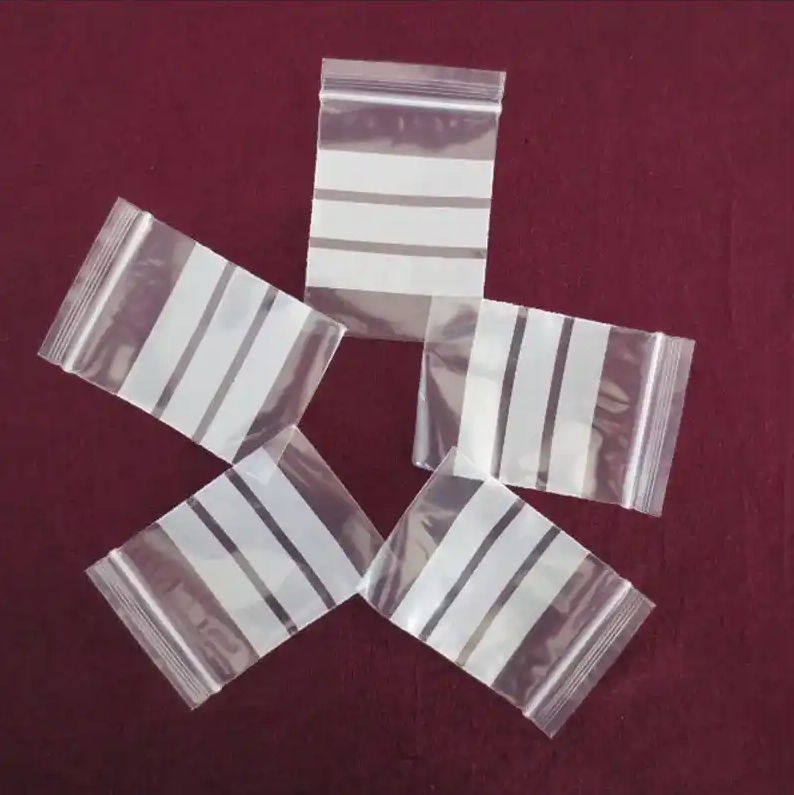
YD Plastics manufactures resealable and ziplock bags in PE/PP for export markets, with RoHS-compliant materials, OEM/ODM support and custom printing. Our team can help you specify the right film, zipper and thickness for your application — contact us for samples and quotations.
-
Contact Us
 Learn moreTel: +86-15602809087 Water Yang
+86-15815931682 Helena He
-
Product Category
-
COMPANY
-
LET'S STAY IN TOUCH


