


Anti-Static Self-Sealing Bags: Material Science and Selection Guide for Electronics Packaging
Back to previous pageElectrostatic discharge (ESD) is one of the most underestimated threats in modern electronics manufacturing and shipping. A single static event as low as 100 volts—well below the threshold a human can feel—can permanently damage an integrated circuit, corrupt a memory module, or shorten the service life of a printed circuit board assembly. Anti-static self-sealing bags, also known as ESD ziplock bags, are engineered specifically to address this invisible but costly risk.
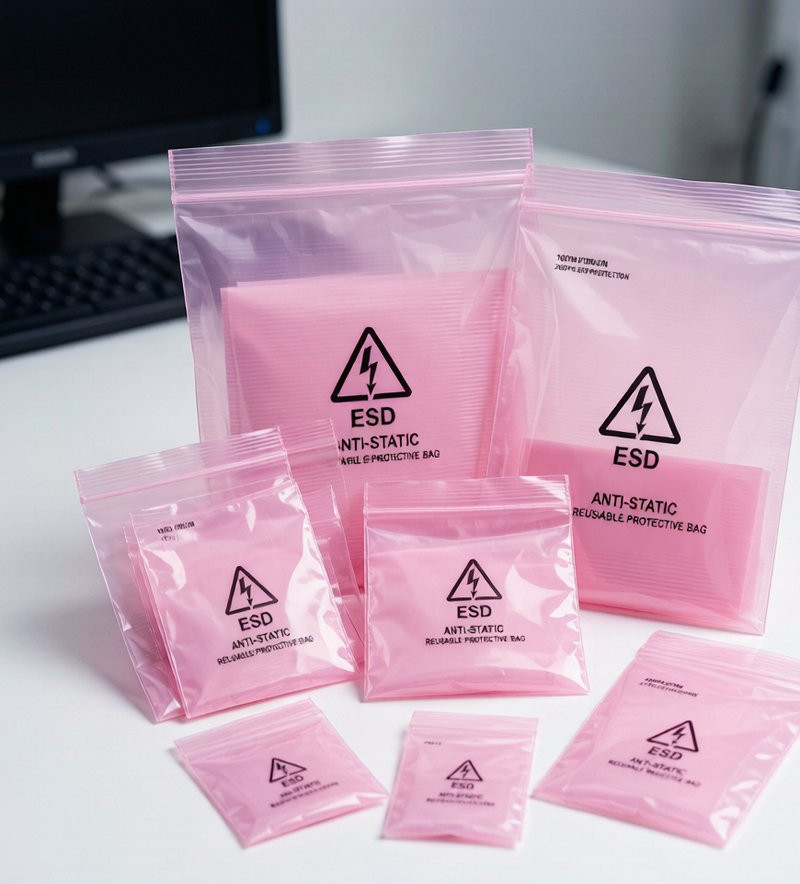
How Anti-Static Treatments Work
Standard polyethylene is a strong electrical insulator with a surface resistivity typically above 10^15 ohms/sq. When two surfaces rub against each other—during bagging, transit, or unpacking—charges accumulate and discharge suddenly. Anti-static bags solve this problem through one of two material science approaches:
- Static-Dissipative Bags: Made by blending polyethylene with a migratory anti-static masterbatch (such as ethoxylated amine or fatty acid ester). The additive migrates to the film surface and attracts a thin layer of moisture from the surrounding air, creating a controlled discharge path with surface resistivity of 10^9–10^11 ohms/sq. These bags are typically pink or blue and are recognized by the ESD triangle symbol.
- Conductive (Metalized) Bags: Constructed as a multi-layer laminate with a thin aluminum or carbon-loaded metallized layer. They provide both ESD shielding (against external static fields) and EMI/RFI shielding, with surface resistivity below 10^5 ohms/sq. These are typically silver or black.
Applications Across the Electronics Supply Chain
Anti-static self-sealing bags are used at virtually every stage where sensitive components are handled: in-circuit testing, board-level packaging, sub-assembly storage, replacement-part distribution, and field-service kits. Common items packed include ICs, LEDs, PCBs, RAM modules, hard drives, sensors, connectors, and finished consumer electronics requiring ESD-safe handling.
Selecting the Right Anti-Static Bag
When choosing ESD packaging, evaluate four key parameters: surface resistivity (must match component sensitivity), thickness (typically 2–6 mil for mechanical protection), sealing reliability (consistent ziplock closure after repeated use), and transparency for visual inspection. YDF Plastics supplies both pink dissipative bags and custom metalized shielding bags in a wide range of standard sizes, with FDA-grade and RoHS-compliant material options available on request.
For buyers sourcing ESD packaging in bulk, partnering with a manufacturer that controls raw material compounding—rather than one that simply converts stock film—ensures consistent resistivity values and reliable protection for every shipment.
-
Jul 31,2026
Anti-Static Self-Sealing Bags: Material Science and Selection Guide for Electronics Packaging
view more -

Jul 31,2026
Food-Safe Self-Sealing Bags: Understanding FDA, LFGB, and EU 10/2011 Standards
view more -
Feb 15,2025
What should be noted when choosing PE high-pressure bags and low-pressure bags?
view more
-
Contact Us
 Learn moreTel: +86-15602809087 Water Yang
+86-15815931682 Helena He
-
Product Category
-
COMPANY
-
LET'S STAY IN TOUCH


